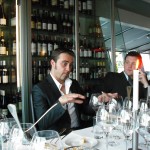
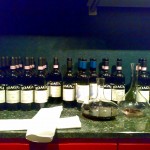
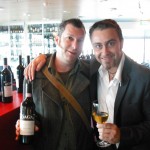
Event: Wine Maker dinner with Ruffino “50 Years of Chianti Classico Riserva”
Location: Potetkjelleren, Bergen Norway
Date: Tuesday April 21, 2009 19:30
Lighting: Very, very dim candle-light, therefore, it was rather difficult assessing the color concentration on the wines
Hosted by Christian Bottegal & Gabrielle Tacchoni
Vintages tasted: 2005, 1999, 1990, 1985, 1977, 1955
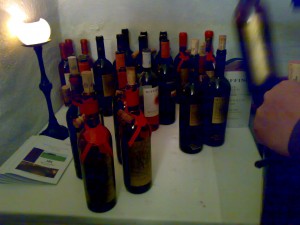
I felt fortunate to be invited to this tasting because I have never had the opportunity to taste a vertical of Chianti’s like this going back 50 years! I have to admit that I can remember often drinking the Ruffno Riserva Ducale Oro in the early to mid-90’s, but haven’t tasted the wine since, so I thought that this was an incredible opportunity to see what I have been missing and to see how their wines age. I also have to admit that I didn’t expect much from a 50 year-old+ Chianti. I was expecting a very light-colored, way past it’s prime Chianti. Read on to find how the Chianti’s were holding up and what they were paired with!
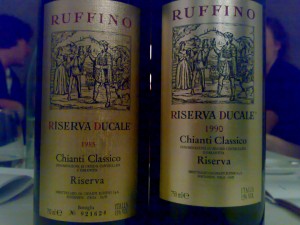
First, a bit of history (from the brochure given to us in the beginning of the event): Back in 1890, Italy’s Duke of Aosta, who regularly passed through Tuscany on his travels to Rome, was so impressed with Ruffino wines that he issued a “Ducal certificate” naming the winery as the preferred supplier to his court. Ruffino crafted well-structured red wines specifically for the Duke’s demanding palate (the “Duke’s Reserve”), which became the inspiration for the wine’s orginal name when released in 1927: Riserva Ducale Chianti Stravecchio.
Riserva Ducale is the only Italian wine that is allowed to include the word “Riserva” in its name, because the name existed long before the production rules of Chianti Classico and Chianti Classico Riserva. Meticulous selection of the finest Sangiovese grapes, and ever more stringent quality controls led naturally to the creation of Riserva Ducale Oro. The wine was first produced in 1947. Made only in outstanding vintages, Riserva Ducale Oro is a true expression of the heart of Tuscan wine.
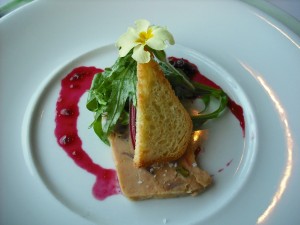
Our historical vintage tour of Ruffino’s Riserva Ducale Oro took us through 3 courses plus a starter and a dessert. The starter was paired with a Pinot Grigio and a Chardonnay (both un-oaked) from other Ruffino Estates. Here’s the first course:
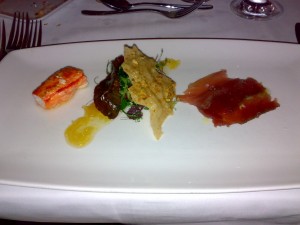
Anise seed and coffee-smoked tuna carpaccio, pan-fried Kamchatka crab with nut filo chips, lemon compote and salad
And now for the wines:
Ruffino Chianti Riserva Ducale Oro 2005:
80% Sangiovese, 20% Cabernet Sauvignon and Merlot
Fermentation: The alcohol fermentation, aided by racking and punching down, took place in thermo-controlled stainless-steel vats at an average temperature of 28° Celsius for 10 days, and was followed by a post-fermentation maceration on the skins for another 8 days.
Aging: After completing the malo-lactic fermentation, the wine was aged first in vats for about 3 months, then in 35/75 hl. oak casks for about 24 months and, lastly, for a minimum of 3 months in the bottle.
Analysis: (at the moment of bottling)
- Alcohol: 13.65%
- Total acidity: 5.00
- PH at 20°C: 3.56
- Residual Sugar: 2.30
Official vintage rating: ****
Appearance: Dark and young as far as I could tell
Nose: The first thing I noticed was the Caberent Sauvignon influence – bell peppers and blackberries. Well-integrated, but heavy use of oak. Big and modern in style. Some dark cherries
Palate: The Cabernet Sauvignon was also in the mouth – blackberries and peppers with gripping tannins from both the fruit and the oak. A modern Chianti with great structure, medium plus acidity and lot’s of oak. Needs some time for the oak to integrate. Extremely well-made.
Ruffino Chianti Riserva Ducale Oro 1999:
85% Sangiovese, 15% Colorino, Cabernet Sauvignon and Merlot
Fermentation: The alcohol fermentation, aided by racking and punching down, took place in thermo-controlled stainless-steel vats at an average temperature of 28° Celsius for 10 days, and was followed by a post-fermentative maceration on the skins for another 8 days.
Ageing: After completing the malo-lactic fermentation, the wine was first aged for 5 months in barriques of second passage, then for an additonal 28 months in 35/75 hl. oak casks. After bottling the wine has been further refined in bottle for 4 months minimum
Analysis: (at the moment of bottling)
- Alcohol: 13.00%
- Total acidity: 4.60
- PH at 20°C: 3.51
- Residual Sugar: 2.60
Official vintage rating: *****
Appearance: Dark and young as far as I could tell, very little age showing
Nose: Mature cherries, cigar box, oak still dominant on the nose.
Palate: Cherries, great acidity. Firm, medium tannins. Oak still dominant on the palate with cigar box notes. A well structured modern Chianti which still needs time:
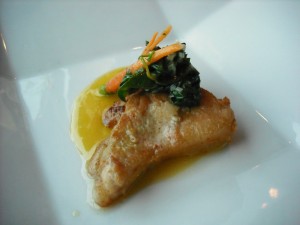
2005 & 1999 Food Pairing
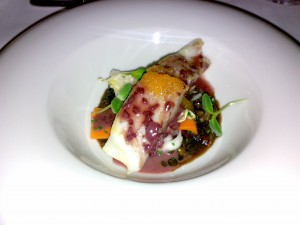
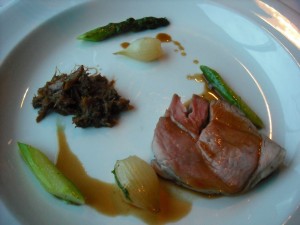
Pan-fried Turbot with pancetta and lentil ragout, beurre rouge and pickled vegetables
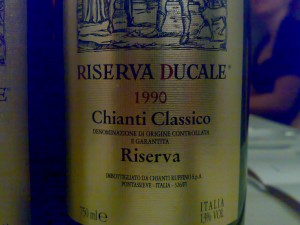
Ruffino Chianti Riserva Ducale Oro 1990:
90% Sangiovese, 7% Canaiolo, 3% Malvasia
Fermentation: The alcohol fermentation, aided by racking and punching down, took place in glass painted concrete tanks at a controlled temperature of 30° Celsius for 2 weeks, and was followed by a post-fermentation maceration on the skins for another 6 days.
Aging: After completing the malo-lactic fermentation, the wine was aged for a minimum of 24 months in 80 hl Slavonian oak casks and further in stainless steel tank
Analysis: (at the moment of bottling)
- Alcohol: 13.24%
- Total acidity: 5.80
- PH at 20°C: 3.35
- Residual Sugar: 1.60
Official vintage rating: *****
Appearance: Dark and still young looking as far as I could tell. Slightly brownish rim.
Nose: Very similar to the other Chianti’s, but no evident oak aromas. Plenty of farmyard aromas right off the bat with a bouquet of red and morell cherries.
Palate: Firm tannins and well-structured. This is a more classical style of Chianti with no barrique use and it’s evident on the palate. Clean fruit, mostly cherries with hints of farmyard aromas. Great acidity. Great concentration. Still young with more room to stretch it’s legs down in the cellar. In my opinion, this has 5-10 more years to reach it’s peak
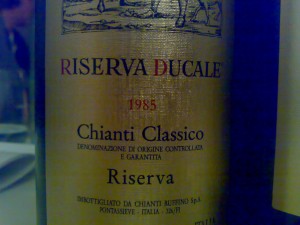
Ruffino Chianti Riserva Ducale Oro 1985:
90% Sangiovese, 7% Canaiolo, 3% Malvasia
Fermentation: The alcohol fermentation, aided by racking and punching down, took place in glass painted concrete tanks at a controlled temperature of 28-32° Celsius for 2 weeks, and was followed by a post-fermentation maceration on the skins for another 8 days.
Ageing: After completing the malo-lactic fermentation, the wine was aged for a minimum of 24 months in 80 hl Slavonian oak casks and further in stainless steel tank
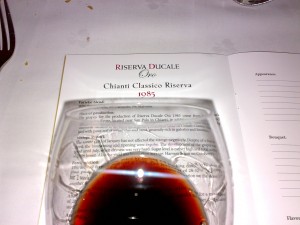 Analysis: (at the moment of bottling)
- Alcohol: 13.53%
- Total acidity: 5.45
- PH at 20°C: 3.40
- Residual Sugar: 1.83
Official vintage rating: *****
Appearance: Dark and still young looking as far as I could tell. Slightly brownish rim. But, still surprisingly darkish.
Nose: Farmyard, plums, cherries and some prunes suggesting that perhaps this Chianti was slightly past it’s prime.
Palate: Plums, prune juice. Still had great tannins and acidity. The Prunes I found on both the nose and palate really hinted at this wines +20 years and suggested perhaps a wine that was slipping, but the structure, acidity and tannins really surprised me. Drink now
1990 & 1985 Food Pairing
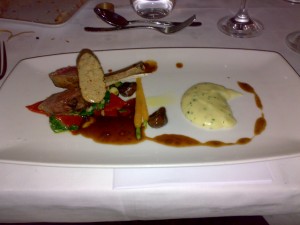
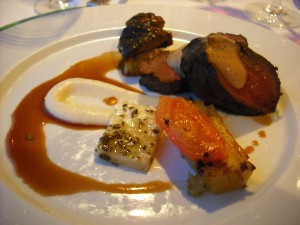
Rack of lamb, creamed potatoes with herbs, glazed chestnuts, house-made pimento and spring onion lamb sausage
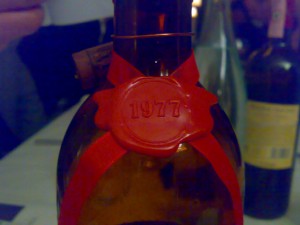
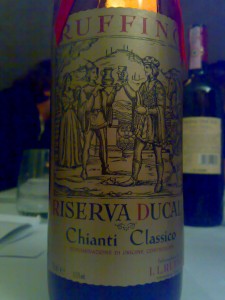
Ruffino Chianti Riserva Ducale Oro 1977:
75% Sangiovese, 10% Canaiolo, 10% Malvasia, 5% Colorino
Fermentation: The alcohol fermentation, aided by racking and punching down, took place in glass painted concrete tanks at a controlled temperature of 28-32° Celsius for 2 weeks, and was followed by a post-fermentation maceration on the skins for another 15 days.
Aging: After completing the malo-lactic fermentation, the wine was aged for a minimum of 12 months in 80 hl Slavonian oak casks and ageing in bottle for minimum 6 months
Analysis: (at the moment of bottling)
- Alcohol: 13.01%
- Total acidity: 5.39
- PH at 20°C: 3.37
- Residual Sugar: 1.96
Official vintage rating: ****
Appearance: Showing age, especially around the edges with some browning, but still quite a deep and concentrated red color.
Nose: Stewed cherries, slight oxidation, and purple gooseberries
Palate: Quite elegant with soft acidity and tannins. Still had good concentration, but no room for storage. Drink now
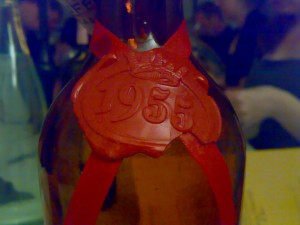
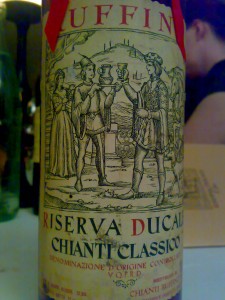
Ruffino Chianti Riserva Ducale Oro 1955:
75% Sangiovese, 10% Canaiolo, 10% Malvasia, 5% Colorino
Fermentation: The alcohol fermentation, aided by racking and punching down, took place in glass painted concrete tanks at a controlled temperature of 28-32° Celsius for 2 weeks, and was followed by a post-fermentation maceration on the skins for another 15 days.
Aging: After completing the malo-lactic fermentation, the wine was aged for a minimum of 12 months in 80 hl Slavonian oak casks and aging in bottle for minimum 6 months
Analysis: (at the moment of bottling)
- Alcohol: 13%
- Total acidity: 5.70
- PH at 20°C: 3.38
- Residual Sugar: 2.05
Official vintage rating: *****
Appearance: Still surprisingly deep and concentrated in color. Even darker than the 1977! Brownish rim. As I mentioned, the lighting in the restaurant was mostly by candle-light and therefore it was hard to assess the color.
Nose: Madeira notes immediately evident. Stewed and dried fruit. Plums, prunes, caramel and cherries
Palate: Great concentration and acidity. Still had firm tannins. Still had great structure. But, this wine had Madeira-like aromas and oxidation. Overall, it still had great mouth feel, acidity, structure and tannins, but the fruit didn’t match the rest of the components. I have never tasted a Chianti of this age, but I am quite sure that this wine was past it’s prime. This really reminded me of some of the great old Boal Madeira’s I have tasted, but drier. A very interesting wine. It sparked many discussions around me at the table. We all enjoyed sipping it and many felt that it was perfect. Although I also thought it was a “perfect” bottle of 50 year-old Chianti, I still debated that the fruit was showing too much age and was at it’s peak years ago. Drink now.
1977 & 1955 Food Pairing (sorry folks, no photo)
Reindeer with morel cream, juniper berries, fried mushrooms, glazed onions & pommes Anna
Overall, I was impressed with the quality of the wine-making in the Riserva Ducale Oro and am quite confident that the latest vintage(s) will age well.