Mar 29, 2009
A tasting note: 2002 David Léclapart L'Amateur Blanc de Blancs Extra-Brut
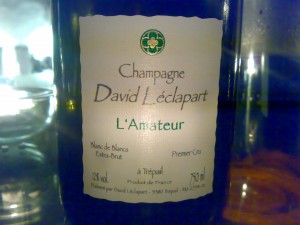
Date tasted: March 25th, 2009 (also on at least 4 other occasions over the last two years.)
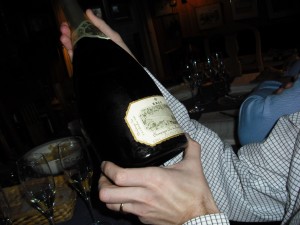
David Léclapart is a biodynamic Champagne house located in Trépail in the Montagne de Reims. Montagne de Reims is the home of the Pinot Noir grape, but Trépail is an exception to this rule. Trépail is a Premier Cru village that grows Chardonnay in the heart of Pinot Noir land.
David has farmed his 2.75ha of vines biodynamically since 1998, producing a measly 7000 bottles per year in total, spread across 4 different wines. He uses minimal sulfur and doesn’t filter.
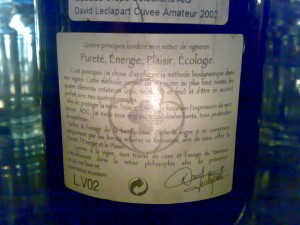
This cuvée is called L’Amateur and from what I gather, it’s his “entry-level” Champagne. It’s a blend of Chardonnay grapes from within Trépail. Although the vintage is not clearly marked on the front label, this IS a vintage Champagne. On the back label in small writting you will find “L.V02”. I don’t know how long the wine has been on the lees, but I would estimate based on purchase date that it spends around 4 years on the lees. This is an Extra Brut (less than 6 grams of sugar per liter).
Appearance: Some development showing. Good bubble structure and fine mousse.
Nose: I have had this cuvée and vintage on at least 4 other ocassions and this Champagne has really developed in the last few years. Intoxicating flinty minerality dominates with pure green and yellow apples with some citrus overtones. Some honey notes and mushrooms in the background as you might expect to find on a developed Chardonnay.
Palate: The best way I have come to describe this Champagne when I have tasted it in the past has been to describe it as a very well made, unoaked Chablis with bubbles. Think Louis Michel or Daniel Dampt and you’ll get it. Ton’s of fresh minerals, yellow apples and hints of flint on the palate. Fine and elegant bubble structure.
This is what I call a transparent wine. Everything is as it should be and easily understood. The fruit and structure are clean. It’s like cooking that fresh meal using the freshest of ingredients and being able to taste every single one of those ingredients. This is why I like naturally made wines. You can taste what should be in the bottle. David respects four principles: purity, energy, pleasure and ecology. And, this is evident.
Some say that Champagne doesn’t develop well when it’s given a low dosage (of sugar in the form of grape must) after dégorgement, but this Champagne with it’s very low dosage has developed marvelously and is simply put, is impressive. I have always loved this Champagne and this experience was no exception. I did feel however, that it was at or very near it’s peak, so if you find a bottle of the 2002, buy it, drink it, enjoy it!
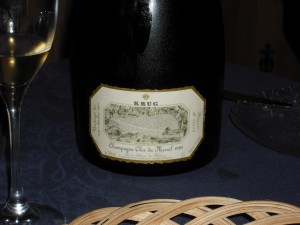
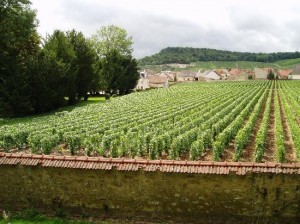 The Clos du Mesnil is an exception to the Krug rule of blending. This wine is 100% Chardonnay from the renowned Clos du Mesnil vineyard within the village of Mesnil-sur-Oger in the Côtes de Blancs. This historic 1.85ha vineyard has been enclosed by a stone wall since 1698 and is set on a southeast-facing slope and is sheltered from the weather by its wall and surrounding houses. This vineyard was purchased by the Krug family in 1971 and started to carefully restore the vineyard to its previous glory by replanting the Chardonnay vines one section at a time. By 1979 the vintage had achieved the quality Krug was aiming for and was therefore the first vintage of the Krug Clos du Mesnil. Only about 12,000 bottles of this wine are made in only the top vintages. Even less bottles are produced in the desireable Magnum size.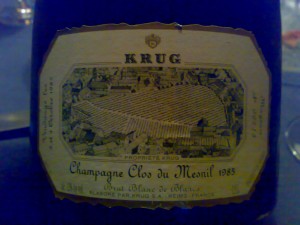
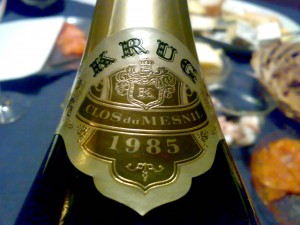 1985 started with the worst frost the residents of Champagne had seen in over 150 years. In January, the temperature outside reached a low of -25 Celsius (-13 Fahrenheit)! At this point, the vines were still hibernating, so no damage done. However, by the time the vines had awoken it was still -15 Celsius (5 Fahrenheit) outside resulting in around 10% of the vineyards freezing. Even into April, outside temperatures were below freezing. Thankfully, the weather changed substantially as the vines flowered and temperatures in August and September were hot. Thanks to the long Indian Summer, harvest was in late September resulting in a small harvest of very concentrated grapes. The wines made from this vintage are still quite youthful and can rest a few more years down in the cellar.